Luc Léger Test (20m Shuttle): Protocol to Calculate Your VO2 Max
The Luc Léger test — also known as the “20m shuttle run” or “beep test” — is probably the most famous VO2 max test globally. If you played sports in middle or high school, you've almost certainly endured it at least once! Created in 1982 by Canadian researcher Luc Léger, it's used everywhere: schools, sports clubs, training centers, and for competitive exams (police, military, firefighters). The principle? You run back and forth over 20 meters to the rhythm of beeps that accelerate every minute.
Test Principle
The test is progressive and maximal: it starts gently at 8.5 km/h and accelerates by 0.5 km/h with each level (1 level = 1 minute). You run back and forth between two lines 20 meters apart, timing your passes with the beeps from an audio recording.
The test stops when you can no longer reach the line before the beep. Miss two consecutive beeps, and your test is over. Your VO2 max is the speed of the last fully completed level.
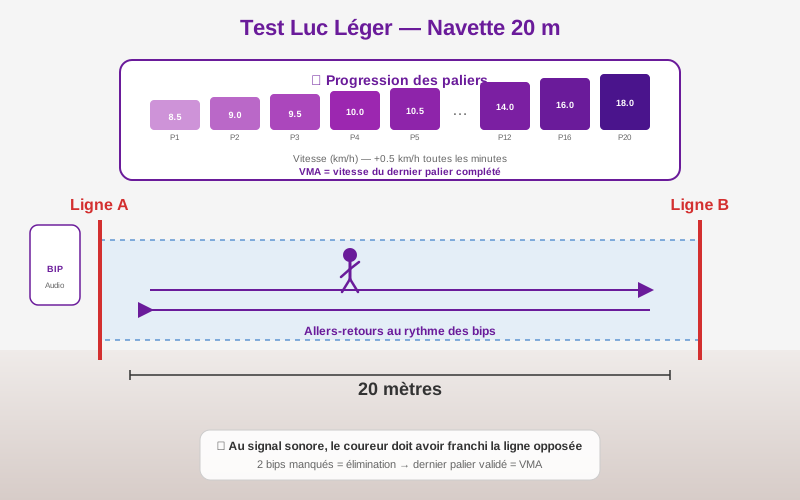
How to Perform the Luc Léger Test
Equipment Needed
- A flat space at least 22 m (approx. 72 ft) long (track, gym, sports field — I've even done this in a parking lot!)
- Two parallel lines spaced exactly 20 m (approx. 65.6 ft) apart (using chalk, tape, or cones)
- An official audio recording of the test (easily found online or via an app)
- A powerful enough speaker so everyone can hear the beeps
- A scoring sheet to record the last completed level for each participant
Step-by-Step Protocol
- Setup: Mark the two lines 20 m (approx. 65.6 ft) apart. Double-check the distance with a tape measure—precision is key.
- Warm-up (10 min): Light jogging + joint mobility exercises + 2-3 progressive accelerations over the course
- Rule Explanation: Each participant must place at least one foot on (or behind) the line at the moment of the beep. If you arrive before the beep, you wait in place and start on the next beep.
- Audio Start: The recording begins with a countdown, then the first level at 8.5 km/h.
- Execution: Everyone runs back and forth. Each minute, a special signal announces the change of level (+0.5 km/h).
- Elimination: If you fail to reach the line by the beep, that's a first warning. On the second missed beep (consecutive), your test is over.
- Result: Record the number of the last completed level for each participant.
Luc Léger Levels Chart
Here's the correspondence between levels and speed (VO2 max):
| Level | Speed (km/h) | Shuttles / level | Cumulative Distance (m) |
|---|---|---|---|
| 1 | 8,5 | 7 | 140 |
| 2 | 9,0 | 8 | 300 |
| 3 | 9,5 | 8 | 460 |
| 4 | 10,0 | 8 | 620 |
| 5 | 10,5 | 9 | 800 |
| 6 | 11,0 | 9 | 980 |
| 7 | 11,5 | 10 | 1,180 |
| 8 | 12,0 | 10 | 1,380 |
| 9 | 12,5 | 10 | 1,580 |
| 10 | 13,0 | 11 | 1,800 |
| 11 | 13,5 | 11 | 2,020 |
| 12 | 14,0 | 12 | 2,260 |
| 13 | 14,5 | 12 | 2,500 |
| 14 | 15,0 | 13 | 2,760 |
| 15 | 15,5 | 13 | 3,020 |
| 16 | 16,0 | 13 | 3,280 |
| 17 | 16,5 | 14 | 3,560 |
| 18 | 17,0 | 14 | 3,840 |
| 19 | 17,5 | 15 | 4,140 |
| 20 | 18,0 | 15 | 4,440 |
To convert your level into VO2 max and get your training paces, use our VO2 Max Calculator, which directly incorporates the Luc Léger test.
Tips for Optimizing Your Performance
- Conserve energy early on: The first levels are slow. Run smoothly and relaxed; there's no need to exhaust yourself.
- Turn efficiently: The changes in direction every 20 m consume energy. My advice: place one foot right on the line, pivot, and restart immediately.
- Stay close to the line: Don't overshoot it by several meters; that's wasted distance.
- Breathe regularly: Adopt a stable and deep breathing rhythm.
- Mentally aim for one level higher than your goal: Personally, I find that most runners stop one level too early because they "think" they can't keep up anymore. Push through it!
Advantages and Limitations
✅ Advantages
- Progressive: no pace management issues
- Can be done indoors (gym)
- Ideal for groups (classes, teams)
- Very motivating: collective emulation encourages pushing oneself
- Requires only a small space (22 m / approx. 72 ft)
- Scientifically validated and universally recognized test
⚠️ Limitations
- Changes in direction slow down actual speed (penalizes taller runners)
- The calculated VO2 max may be underestimated by 0.5 to 1 km/h compared to the VAMEVAL test
- Requires a reliable audio recording
- Risk of injury from abrupt changes in direction
- Difficulty in precise evaluation when many runners participate simultaneously
Luc Léger vs. VAMEVAL: What's the Difference?
Both tests are progressive and start at 8.5 km/h. The major difference is the mode of movement:
- Luc Léger: 20m shuttle runs → changes in direction that consume energy
- VAMEVAL: continuous loop running on a marked circuit → zero changes in direction
In practice, the VAMEVAL often yields a VO2 max that is 0.5 to 1 km/h higher than the Luc Léger, because you don't lose energy making turns.
Key Takeaway: The Luc Léger test is the most practical and accessible VO2 max test. You can perform it anywhere, even in a gym, and it's suitable for all fitness levels. For an even more precise estimate, supplement it with a VAMEVAL test. In any case, find your VO2 max instantly on our VO2 max calculator.
Frequently Asked Questions
How does the Luc Léger test work?
The test involves running back and forth over 20m to the rhythm of audio beeps. The speed starts at 8.5 km/h and increases by 0.5 km/h each minute. The test stops when you can no longer reach the line before the beep. Your VO2 max is the speed of the last completed level.
What VO2 max does each level correspond to?
Level 1 = 8.5 km/h, Level 5 = 10.5 km/h, Level 10 = 13 km/h, Level 13 = 14.5 km/h, Level 16 = 16 km/h, Level 20 = 18 km/h. Each level adds 0.5 km/h. Use our VO2 max calculator to get your paces.
What is the difference between the Luc Léger and the VAMEVAL test?
The Luc Léger involves 20m shuttle runs, whereas the VAMEVAL test involves continuous loop running. The VAMEVAL is more accurate because there are no changes in direction, but it requires more space (track or large field).
Can the Luc Léger test be done indoors?
Yes! In fact, that's one of its big advantages. It can be performed in a gym, a wide hallway, or any indoor space at least 22 meters (approx. 72 ft) long. This is why it is so popular in schools.