The 12-Minute Cooper Test: How to Determine Your Maximal Aerobic Speed (MAS)
The Cooper Test, invented in 1968 by Dr. Kenneth Cooper for the U.S. Army, is probably the most well-known Maximal Aerobic Speed (MAS) test in the world. The concept is incredibly simple: you run as far as possible for 12 minutes. The distance you cover gives you an estimate of your MAS and VO2max. It's still used for police and gendarmerie (military police) entrance exams and by many sports clubs. Personally, I think it's a timeless classic for evaluating your aerobic fitness.
The Principle Behind the Cooper Test
The idea is straightforward: the distance you cover in 12 minutes is directly related to your maximal aerobic capacity (VO2max). The farther you run, the higher your VO2max — and consequently, your MAS.
Unlike progressive tests (like the Beep Test (Luc Léger) or the VAMEVAL Test), the Cooper Test is a self-paced test: you manage your effort throughout the entire duration. This is both its strength — super simple to organize — and its weakness — you need to have a good sense of your pace to avoid burning out.
How to Perform the Cooper Test
Equipment Needed
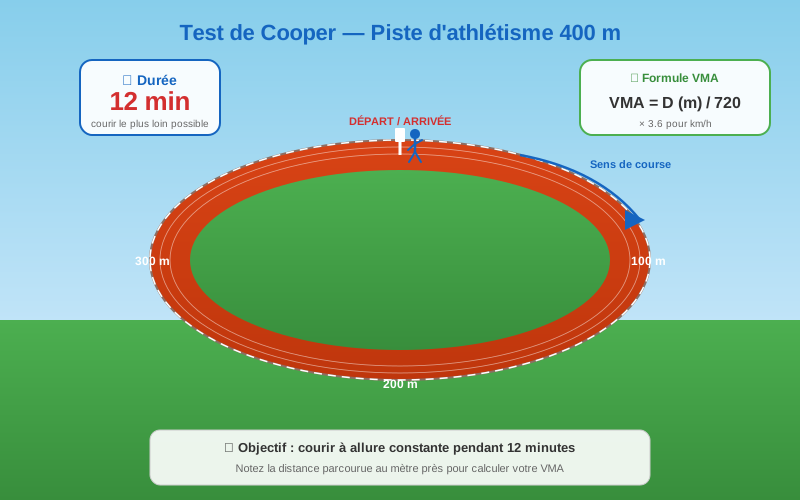
- An athletic track (400m / quarter-mile) — ideal for precise distance measurement
- A stopwatch or your GPS watch
- A whistle or audible signal to mark the start and end
- Something to mark the distance (a cone or marker)
Step-by-Step Protocol
- Warm-up (10-15 min): gentle jog + a few progressive accelerations to prepare your body for the effort
- Positioning: stand on the starting line
- Start: at the signal, you're off — the goal is to cover the greatest possible distance in exactly 12 minutes
- Pace Management: start at a pace you believe you can maintain for the entire duration — trust me, it's better to start a little cautiously and speed up at the end than the other way around
- End of Test: at the 12-minute signal, stop and mark your position on the track
- Measurement: count the number of full laps + the fraction of the last lap to get your total distance in meters
- Cool-down: 5-10 minutes of walking, then some light stretching
Tips for Optimal Results
- Perform the test when you are well-rested (no intense workout the day before)
- Choose a day with suitable weather conditions (not too hot, no strong headwind)
- Run on a flat track — elevation changes will skew everything
- Wear light shoes suitable for track running
- Hydrate well beforehand (but not immediately before the start)
Calculating Your Maximal Aerobic Speed (MAS) from the Cooper Test
The formula for calculating your Maximal Aerobic Speed (MAS) from the Cooper Test is:
Formula: MAS (km/h) = Distance covered (m) ÷ 720 × 3.6
Or more simply: MAS (km/h) = Distance (m) ÷ 200
Distance / MAS Conversion Table
| Distance (m) | MAS (km/h) | Level |
|---|---|---|
| 2,000 | 10.0 | Beginner |
| 2,200 | 11.0 | Beginner + |
| 2,400 | 12.0 | Intermediate |
| 2,800 | 14.0 | Proficient |
| 3,000 | 15.0 | Good Level |
| 3,200 | 16.0 | Very Good |
| 3,600 | 18.0 | Excellent |
| 4,000 | 20.0 | Elite |
To automatically calculate your MAS from your Cooper distance, use our Maximal Aerobic Speed (MAS) calculator which directly integrates the Cooper Test.
Estimating Your VO2max
The Cooper Test also allows you to estimate your VO2max with the following formula:
VO2max (ml/kg/min) = (Distance in meters − 504.9) ÷ 44.73
For example, if you ran 3,000 m: VO2max ≈ (3000 − 504.9) ÷ 44.73 ≈ 55.8 ml/kg/min. To learn more, check out our VO2max calculator.
Advantages and Limitations of the Test
✅ Advantages
- Very simple to organize: a track + stopwatch are enough
- Can be done alone or in a group
- Universally known and recognized
- Allows estimation of MAS and VO2max
- Ideal for tracking progress over time
⚠️ Limitations
- 12 minutes is too long to maintain true MAS pace → tends to underestimate MAS
- Requires good pace management (difficult for beginners)
- Influenced by motivation and mental capacity for discomfort
- Sensitive to weather conditions (wind, heat)
- Less precise than progressive tests (Beep Test, VAMEVAL)
The Cooper Test vs. Other MAS Tests
The Cooper Test isn't the only test to evaluate your MAS. Here's how it compares to other field tests:
- Half-Cooper Test (6 min): same principle but over 6 minutes — the effort is more intense and closer to your true MAS. I recommend it if you have some experience.
- Beep Test (Luc Léger): a progressive shuttle run test over 20m — very common in schools and clubs. The speed increases automatically, so there's no need to worry about pace management.
- VAMEVAL Test: a progressive loop test with cones every 20m — considered the most accurate since there are no changes in direction.
My takeaway: The Cooper Test is perfect for an initial fitness assessment or for testing a group. For a more precise estimation of your MAS, opt for a progressive test like the Beep Test or the VAMEVAL. In any case, use our MAS calculator to get your result instantly.
Frequently Asked Questions
What is the formula for calculating MAS from the Cooper Test?
MAS (km/h) = Distance covered in meters ÷ 720 × 3.6. More simply: MAS = Distance (m) ÷ 200. For example, 3,000 m covered in 12 minutes gives an MAS of 15 km/h. Use our MAS calculator for instant results.
Is the Cooper Test reliable for estimating MAS?
The Cooper Test provides a good estimate, but it tends to slightly underestimate MAS because 12 minutes is too long to maintain maximal aerobic intensity. The Half-Cooper Test (6 min) or the Beep Test (Luc Léger) are often considered more accurate.
Can the Cooper Test be performed on the road?
It is preferable to conduct the test on an athletic track for precise distance measurement. A flat, marked road can be suitable if you have a reliable GPS, but the results will be less accurate (GPS typically has a 1-3% margin of error).
How often should the Cooper Test be repeated per year?
It is recommended to perform the test 2 to 4 times a year (e.g., at the beginning of each training cycle) to track your progress. Allow at least 6 to 8 weeks between tests to observe significant changes.