High Drop vs. Zero Drop Running Shoes: How to Choose?
Shoe "drop" – the height difference between the heel and forefoot – has become a major selection criterion for running shoes. Minimalists swear by zero drop for a "natural" stride. Traditionalists stick to 10-12 mm. Who's right? I've looked into the question, and as is often the case, the answer is more nuanced than either side claims.
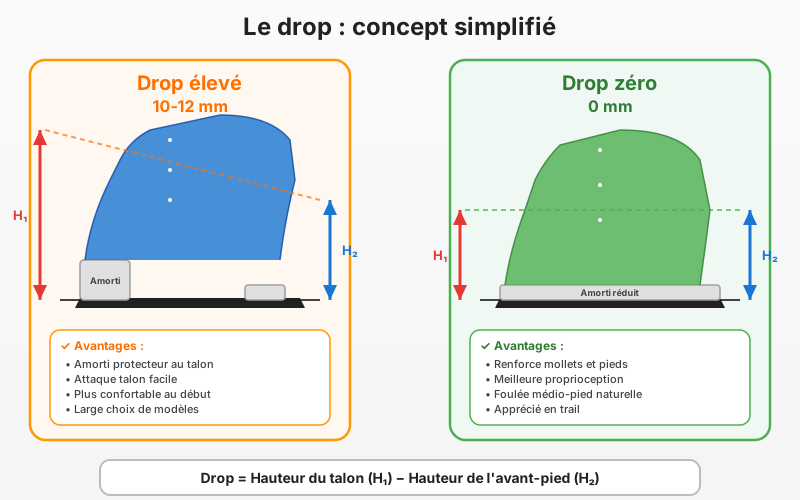
What Exactly is Shoe Drop?
A 10 mm drop means the heel is 10 mm higher than the forefoot. A 0 mm drop means the shoe is flat. Most traditional shoes have an 8-12 mm drop. Minimalist models offer 0 to 4 mm. Carbon-plated super shoes often have a moderate drop (6-8 mm) despite enormous cushioning.
How Drop Influences Your Stride
High Drop → encourages heel strike
A 10-12 mm drop inclines the foot and facilitates heel contact. The load is shifted more towards the knee and shin. This is the gait pattern for the vast majority of runners, and it's not a problem in itself.
Low/Zero Drop → encourages midfoot landing
Without heel elevation, you tend to land flatter or even on your forefoot. This transfers the load to the calves, Achilles tendon, and metatarsals. It's not inherently more "natural" – it's just a different pattern (see our article on midfoot striking).
High Drop (8-12 mm)
- Comfortable for heel strikers
- Protects the Achilles tendon
- Easy transition (it's the standard)
- Wide range of models available
Low/Zero Drop (0-4 mm)
- Strengthens calves and feet
- May improve proprioception
- Consistent with a midfoot stride
- Favored in trail running for ground feel
What the Studies Say
The question has been well-researched, and the verdict is quite clear: there's no universally "better" drop. A large randomized study (Malisoux et al., 2016, BJSM) followed 553 runners divided into three groups (10, 6, and 0 mm drop) for 6 months. Result: no significant difference in injury rates.
What matters more than the drop itself is the change in drop. Abruptly switching from 12 to 0 mm can overload the calves and Achilles tendon – this is the most common cause of minimalism-related injuries. The transition must be gradual: over several months, alternating old and new drop shoes, with reduced mileage at first.
How to Choose Your Drop
- If you run without issues — don't change anything. The best drop is the one you feel comfortable with.
- Knee or shin pain — a lower drop might be beneficial, as it transfers some of the load to the calves.
- Achilles tendon issues — a higher drop reduces tension on the tendon. Avoid zero drop while pain persists.
- For racing — a moderate drop (4-8 mm) complements a natural midfoot landing at high speed, consistent with your running pace.
- Diversify — alternating two pairs of shoes with different drops can reduce repetitive stress.
My take: shoe drop is neither good nor bad in itself. It's one parameter among others. No specific drop prevents injuries or guarantees performance. What matters is consistency between the shoe, your stride, your paces, and especially gradual changes if you switch. The best advice is to stick with what works if everything is going well.
Frequently Asked Questions
What is shoe drop in running shoes?
Shoe drop is the difference in height (in mm) between the heel and the forefoot. A classic drop is 8-12 mm, while a low drop is 0-6 mm.
Is a low drop better than a high drop?
Not necessarily. A low drop puts more stress on the Achilles tendon and calves. A high drop places more load on the knees. The best drop is the one your body is adapted to.
How do I transition to a lower drop?
Gradually: reduce by 2-4 mm at a time, start with short runs, and allow 3-4 weeks for adaptation between each change.