Half-Cooper Test (6 minutes): Accurately Estimate Your Maximal Aerobic Speed (MAS)
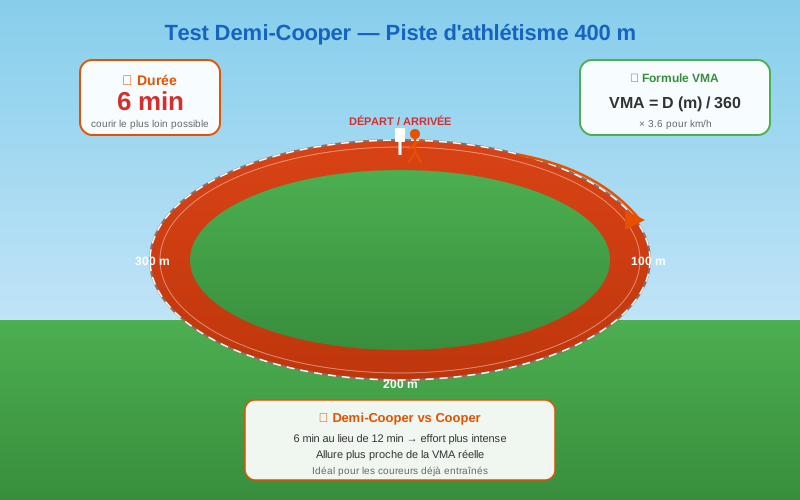
The Half-Cooper Test is a variation of the classic Cooper Test where you only run for 6 minutes instead of 12. Why? Because, in theory, you can maintain your Maximal Aerobic Speed (MAS) for 4 to 8 minutes. By shortening the test, you run at a pace closer to your true MAS, making the estimation more accurate. Based on my research, it's the most reliable "free-pace" test.
Why is the Half-Cooper Test More Accurate?
Your MAS is the speed at which your oxygen consumption is at its maximum. You can sustain this intensity for approximately 4 to 8 minutes. The issue with the classic Cooper Test is that 12 minutes is too long: you exceed your "time limit at MAS" and are forced to slow down, which then underestimates your true MAS.
With 6 minutes, you're right within the optimal window for sustaining your MAS. The result: the test much more accurately reflects your true fitness.
"The sustainable time at MAS typically ranges between 4 and 8 minutes. A 6-minute test allows for full engagement of the aerobic system without exceeding the capacity to maintain maximum intensity."
— Billat V., Physiology and Training MethodologyHow to Perform the Half-Cooper Test
Equipment Needed
- A 400m running track (ideal) or a measured flat course
- A stopwatch
- A cone or marker to indicate your finishing position
Step-by-Step Protocol
- Thorough warm-up (15 min): progressive jogging + 3-4 striders (short sprints at a sustained pace). The warm-up is truly crucial here because you'll be pushing hard from the start.
- Positioning: Line up at the starting line.
- Start: At the signal, run as far as possible for exactly 6 minutes.
- Pace Strategy: Start at a pace you believe you can sustain for 6 minutes — the effort should be near-maximal. You should finish "all-out" over the last 200 meters.
- End of Test: At the 6-minute signal, mark your position.
- Measurement: Calculate the total distance covered in meters.
- Cool-down: Walk + very light jogging for 10 minutes.
Calculating Your MAS
The Half-Cooper formula is even simpler than the Cooper Test's:
Formula: MAS (km/h) = Distance covered (m) ÷ 100
Example: 1,500 m in 6 min → MAS = 1,500 ÷ 100 = 15.0 km/h
Distance / MAS Conversion Table
| Distance (m) | MAS (km/h) | Level |
|---|---|---|
| 1,000 | 10.0 | Beginner |
| 1,100 | 11.0 | Advanced Beginner |
| 1,200 | 12.0 | Intermediate |
| 1,400 | 14.0 | Experienced |
| 1,500 | 15.0 | Good Level |
| 1,600 | 16.0 | Very Good |
| 1,800 | 18.0 | Excellent |
| 2,000 | 20.0 | Elite |
For an automatic calculation, head over to our MAS calculator, which includes the Half-Cooper Test.
Common Mistakes to Avoid
- Starting too fast: This is the #1 mistake (and personally, I've fallen into this trap more than once). If you sprint the first 2 minutes, you'll bonk, and your result will be inaccurate.
- Starting too slowly: Conversely, if you start too cautiously, you won't reach your true potential, even if you speed up at the end.
- Neglecting the warm-up: For a 6-minute effort, your cardiovascular system needs to be "primed." Plan for at least 15 good minutes of warm-up.
- Taking the test while fatigued: Avoid any strenuous workouts in the 48 hours before the test.
Cooper vs. Half-Cooper: Which to Choose?
🏃 Half-Cooper (6 min)
- More accurate MAS estimation
- Effort within the MAS sustainable zone
- Less taxing for recovery
- Ideal for trained runners
🕐 Classic Cooper (12 min)
- More accessible for beginners
- Also allows for VO2 max estimation
- More forgiving on pace management
- Historical and universal benchmark
In practice, many coaches recommend performing both tests and comparing the results. If your Half-Cooper MAS is significantly higher than your Cooper MAS, it means you have a good ability to push hard for shorter durations — an asset for distances from 1,500m to 5km.
Frequently Asked Questions
What is the formula for the Half-Cooper Test?
MAS (km/h) = Distance covered in meters ÷ 100. For example, 1,500 m in 6 minutes = MAS of 15 km/h. It's the simplest formula among all MAS tests. Calculate yours with our MAS calculator.
Is the Half-Cooper Test more accurate than the classic Cooper Test?
Yes, because 6 minutes is closer to the maximal sustainable time at MAS (4 to 8 min depending on fitness level). The pace adopted is therefore more representative of true MAS than over 12 minutes, where the runner is forced to slow down.
Is the Half-Cooper Test suitable for beginners?
The Half-Cooper Test requires running at a very high intensity for 6 minutes. It's best to have a few months of training under your belt. For true beginners, the Cooper Test (12 min) is more accessible as the pace is less intense.
Can Cooper Test and Half-Cooper Test results be compared?
Yes, but expect to get a slightly higher MAS with the Half-Cooper Test (about 0.5 to 1 km/h higher). This is normal: the 6-minute effort is closer to MAS intensity than the 12-minute effort.